I Only Have Two Minutes
Start With the Question That Matters Most
You do not need to read every section in order. Choose the path that best describes your priorities, or use the quiz for a personalized starting point.
Start With the Lineup
Which Mazda Models Use Hybrid or Plug-In Hybrid Power?
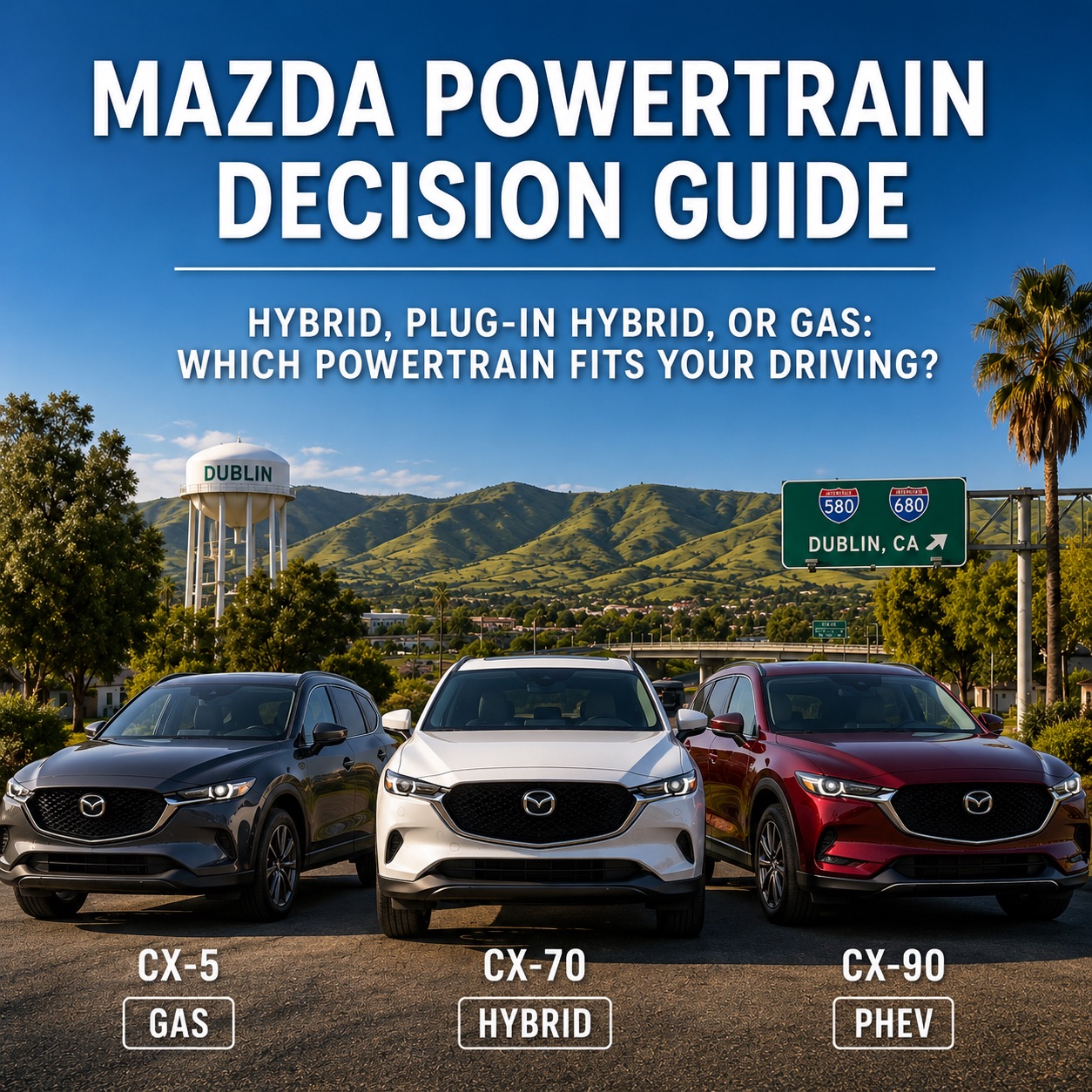
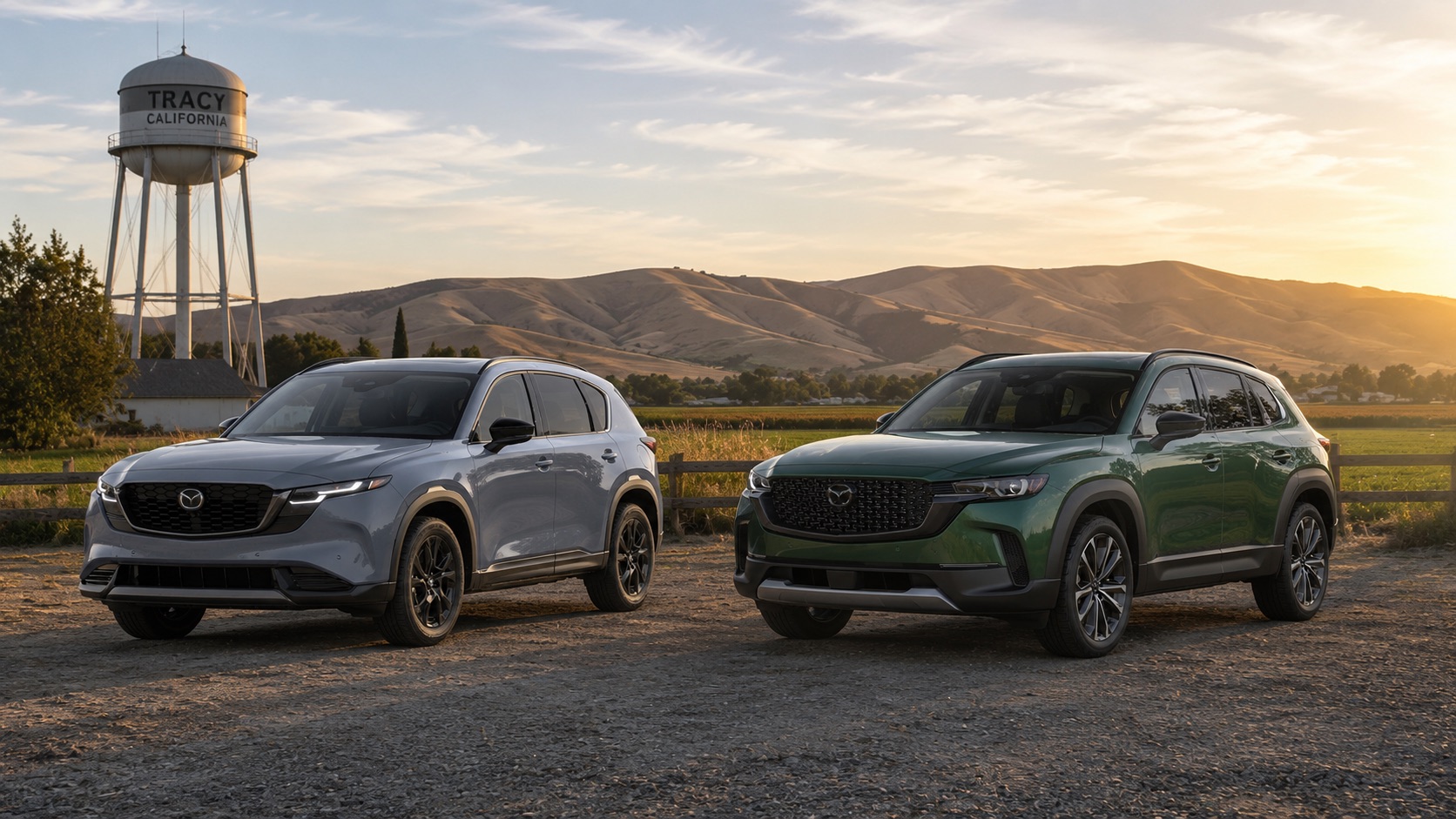
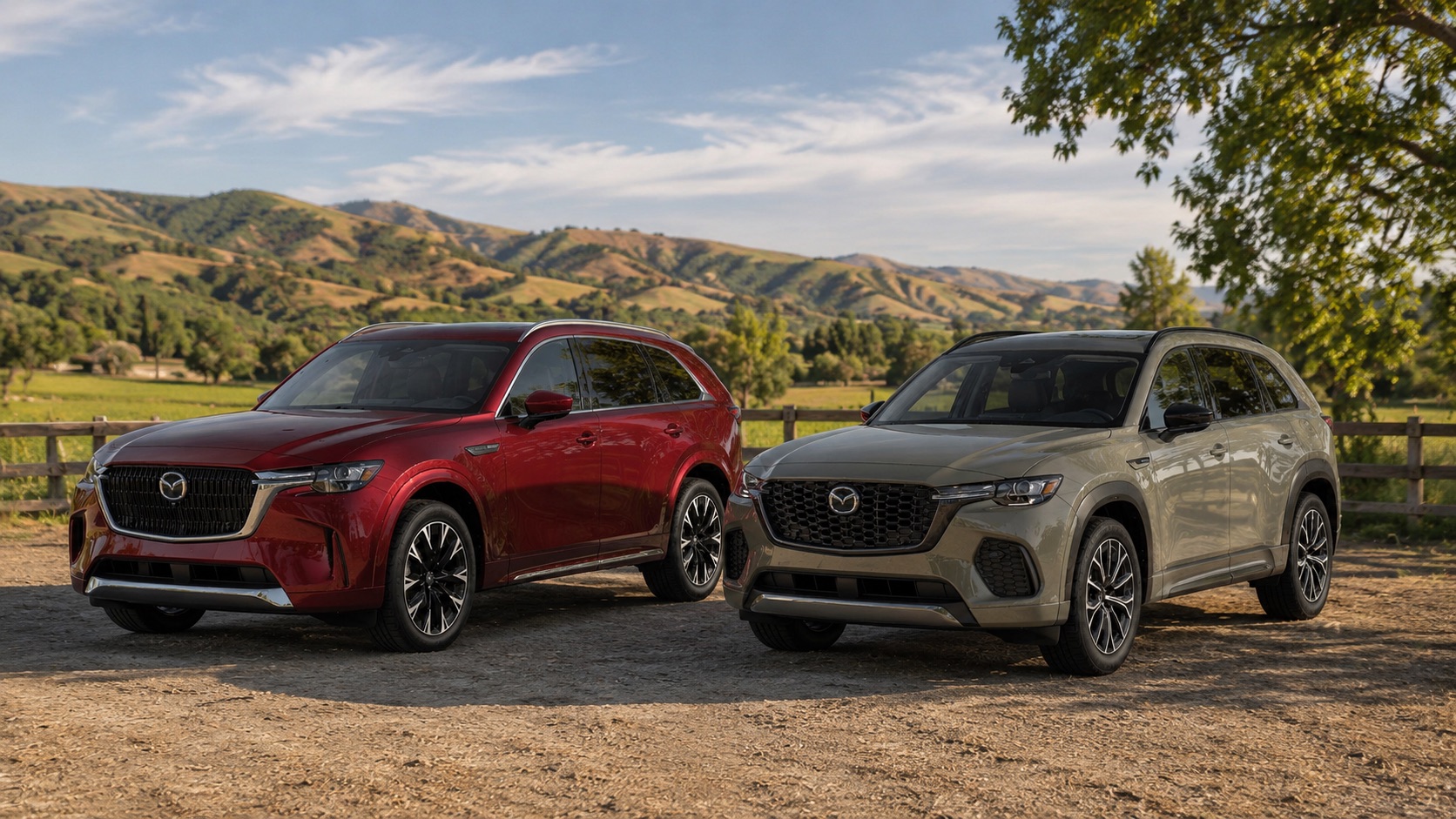
Mazda's current U.S. electrified SUV lineup follows three distinct paths. The CX-50 Hybrid is a traditional hybrid that charges itself through normal driving and regenerative braking. The CX-70 PHEV and CX-90 PHEV add a larger battery that can be plugged in, allowing electric-only driving for shorter trips before the gasoline engine supports longer travel.
Gasoline choices remain available throughout the broader Mazda SUV lineup, including the CX-5, CX-50, CX-70, and CX-90. That matters because shoppers are not choosing between “modern” and “outdated” powertrains. They are choosing among different tools for different driving patterns.
| Current Mazda SUV Powertrain Paths | ||||
|---|---|---|---|---|
| Model | Gas | Traditional Hybrid | Plug-In Hybrid | Primary Role |
| CX-5 | Yes | No current U.S. model | No | Comfort-focused compact gas SUV |
| CX-50 | Yes | Yes | No | Five-passenger versatility with gas or no-plug hybrid choices |
| CX-70 | Yes | No | Yes | Larger premium two-row SUV |
| CX-90 | Yes | No | Yes | Three-row family and passenger flexibility |
Plain-English Comparison
Gas vs. Hybrid vs. PHEV: What Changes in Daily Ownership?
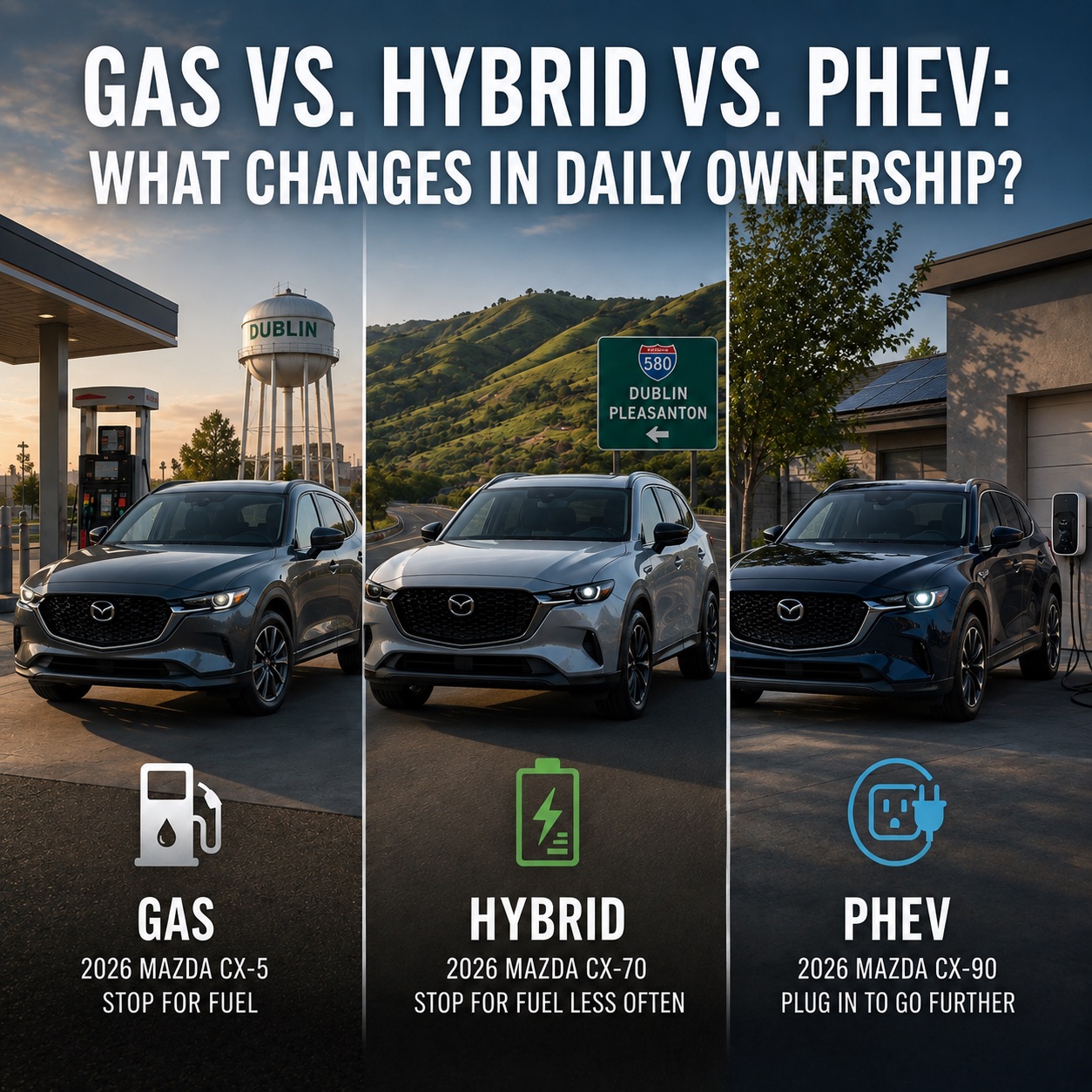
A gasoline SUV uses its engine as the primary source of power. A traditional hybrid adds electric motors and a small battery to improve efficiency, but the vehicle handles battery charging automatically. A plug-in hybrid uses a larger battery that can be charged from an outlet, allowing a meaningful portion of short-distance driving to occur on electric power.
The practical difference is routine. A gas model asks you to stop for fuel. A traditional hybrid asks you to do the same thing less often. A PHEV asks you to plug in regularly if you want to capture its main advantage.
| Mazda Powertrain Ownership Comparison | |||
|---|---|---|---|
| Decision Factor | Gas | Traditional Hybrid | Plug-In Hybrid |
| External charging | No | No | Recommended for full benefit |
| Primary energy source | Gasoline | Gasoline plus electric assistance | Stored electricity for shorter trips, gasoline for longer use |
| Best routine | Long, variable, or charge-free driving | Mixed commuting with no desire to plug in | Predictable short trips with reliable charging |
| Main advantage | Familiar ownership and quick refueling | Improved MPG without behavior change | Electric local driving with gas-trip flexibility |
| Main tradeoff | More fuel use | No plug-in electric range | Higher complexity and reduced benefit if rarely charged |
Compare the Model Paths
Which Mazda Model and Powertrain Fit Your Priorities?
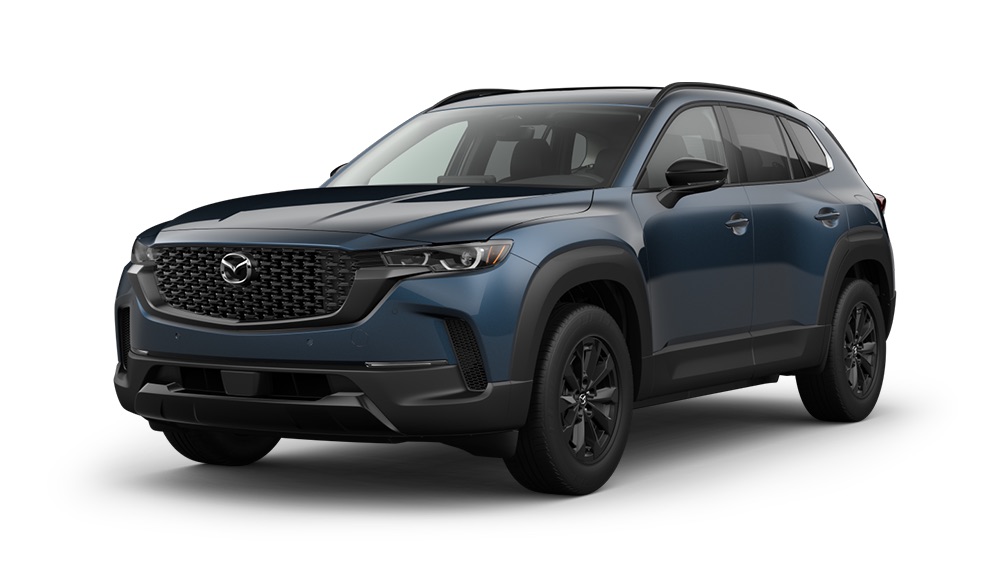
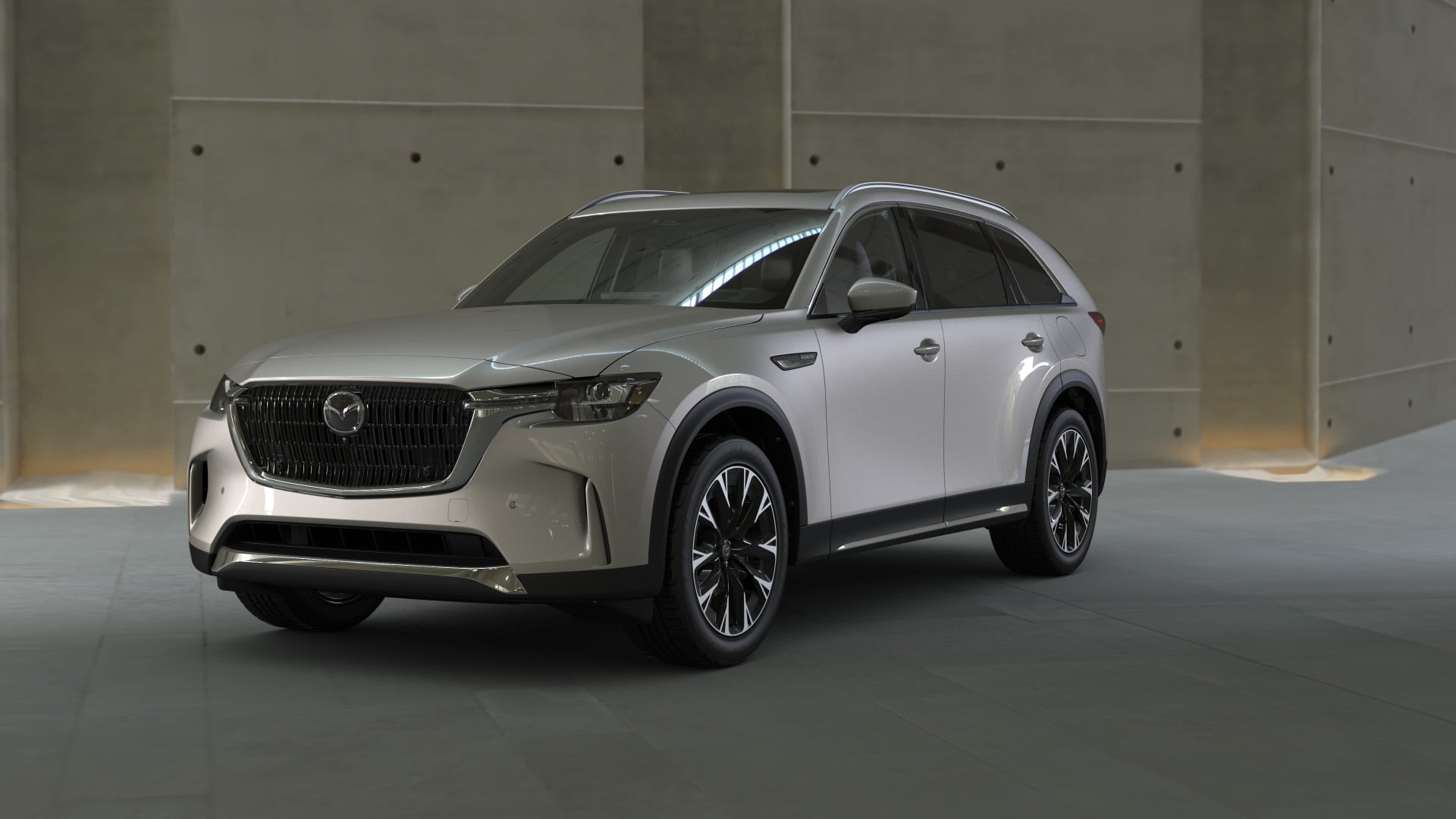
Select a model path to compare its ownership role, best-fit driver, main tradeoff, and the next Mazda worth considering. This selector keeps the article shorter without hiding the information that drives the decision.

Local Ownership Context
How Do These Powertrains Fit Tracy-Area Driving?
The route alone does not choose the vehicle. These examples show how charging access, passenger count, cargo needs, and highway frequency can change the recommendation across the Central Valley and East Contra Costa County.
Tracy, Mountain House, and Manteca Daily Routines
Start with: CX-50 Hybrid for five-passenger efficiency; CX-70 or CX-90 PHEV when home charging and the larger body style fit.
School runs, shopping, local appointments, and short I-205 or I-5 segments create the repeated lower-distance driving where hybrid assistance or regular PHEV charging can be useful.
Tracy-to-Bay Travel on I-580 / I-205
Start with: CX-50 Hybrid, then compare gas and PHEV alternatives against your actual charging plan.
A traditional hybrid can improve efficiency without requiring the commute to fit inside electric range. A PHEV becomes more convincing when charging is dependable at home and the shorter local miles around the commute remain a meaningful part of the week.
San Joaquin and Stanislaus County Family Travel
Start with: Body size first—CX-50 Hybrid for five seats, CX-70 for a roomier two-row cabin, or CX-90 for three rows.
Trips among Stockton, Lodi, Modesto, Elk Grove, and surrounding San Joaquin or Stanislaus County communities can mix errands, sports equipment, passengers, and longer freeway drives. Confirm seating and cargo fit before letting fuel economy decide the vehicle class.
Brentwood, Oakley, Antioch, and the Highway 4 Corridor
Start with: CX-50 Hybrid for mixed suburban/freeway use; CX-70 PHEV for larger two-row space with reliable charging.
Drivers connecting through Pittsburg, Bay Point, or Concord may combine local congestion with sustained highway travel. The PHEV case depends less on the city name than on how much charging-supported driving happens before and after the freeway portion.
Delta and Foothill Recreation
Start with: CX-50 Hybrid or gas CX-50 for five-passenger gear flexibility; CX-70 or CX-90 when people and cargo require more room.
Trips toward Discovery Bay, Rio Vista, the Delta, Clayton, or the Mount Diablo foothills make cargo access, passenger comfort, and return-trip distance more important than one efficiency number. A PHEV can still fit when it is charged for the local week; gas can be simpler when recreation travel dominates.
Charging Without the Confusion
Do You Need a Level 2 Charger for a Mazda PHEV?
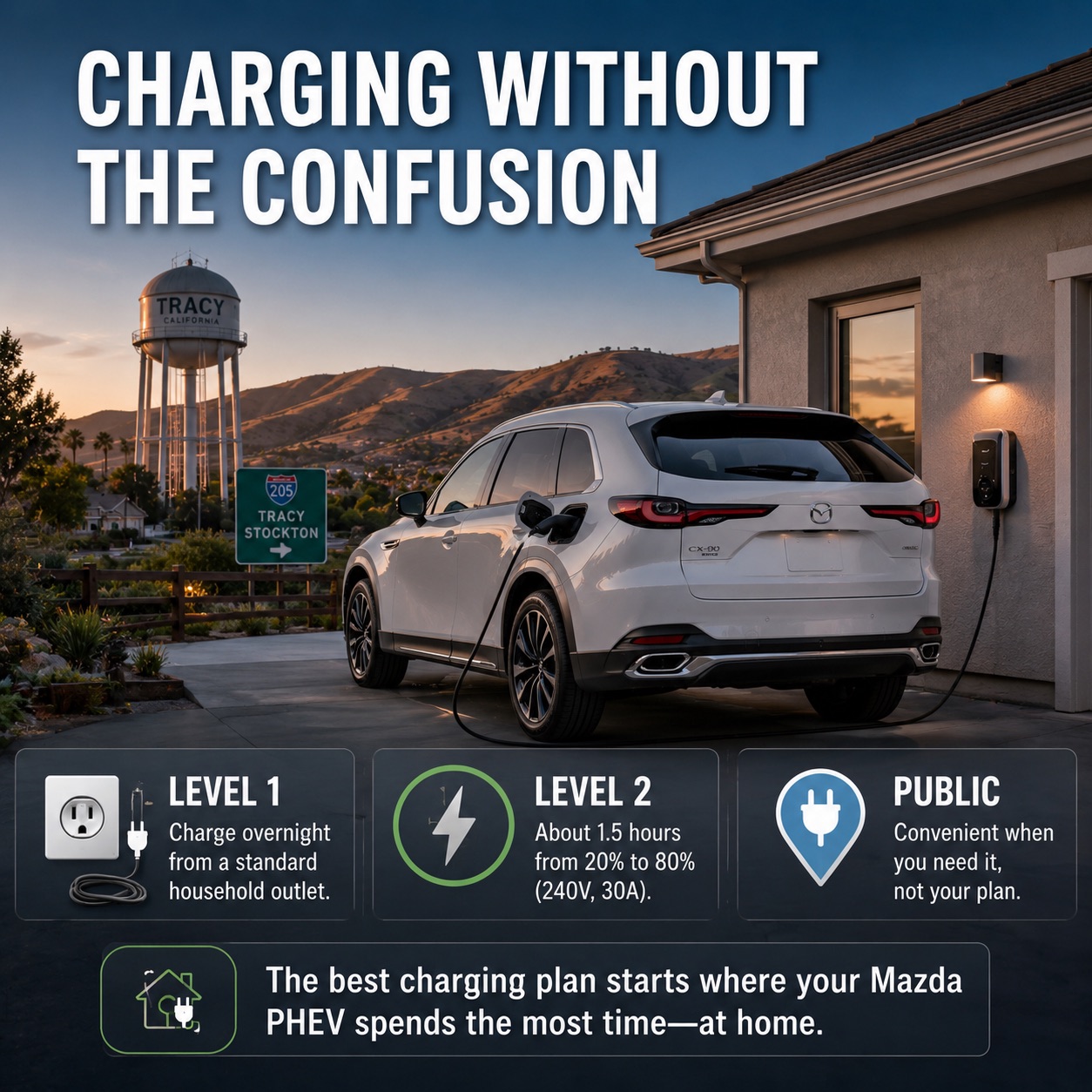
No. Mazda states that its PHEVs can charge overnight from a household outlet using the supplied Level 1 cable. A professionally installed Level 2 setup can shorten charging time; Mazda cites approximately 1.5 hours under specified 240-volt, 30-amp conditions for charging from 20% to 80%.
That does not mean every owner needs to install Level 2 equipment. The decision depends on how much charge you use each day, how many hours the vehicle stays parked, and whether another electrified vehicle shares the same outlet or charger.
Public charging is useful, but a PHEV recommendation should not be built around hoping a public station is available every day. The strongest ownership case usually starts with dependable charging where the vehicle already spends long periods parked.
| Charging Decision Guide | ||
|---|---|---|
| Household outlet available overnight | Level 1 may cover the routine | Ask whether the available parking location and outlet are appropriate. |
| Frequent daily use with shorter parking windows | Level 2 may be more convenient | Installation cost and electrical capacity need separate verification. |
| Apartment or street parking | PHEV benefit may be harder to capture | Compare the CX-50 Hybrid before assuming public charging will solve the routine. |
| Occasional missed charge | Vehicle continues with gasoline support | Missing an occasional charge is different from rarely charging at all. |
Ownership Reality
Fuel Cost, Maintenance, and Long-Term Questions
The least expensive vehicle to fuel is not automatically the least expensive vehicle to own. Purchase price, financing, insurance, electricity rates, gasoline prices, annual mileage, charging frequency, trim selection, and resale conditions all affect the outcome.
A traditional hybrid earns its value gradually through reduced fuel use. A PHEV can shift a meaningful share of local mileage from gasoline to electricity, but only when it is charged. A gas model can cost less to acquire in some configurations and may better match shoppers who would not use the electrified hardware consistently.
Fuel and Energy
Compare your real annual miles, local electricity rate, gasoline cost, and how often the PHEV would actually be charged. Avoid savings claims based on a driving pattern you do not have.
Routine Maintenance
PHEVs still have gasoline engines and therefore retain engine-related maintenance requirements. Hybrid systems can reduce some friction-brake use through regenerative braking, but service needs depend on use and condition.
Battery Coverage
Mazda lists a High Voltage Battery Limited Warranty of 96 months or 100,000 miles for the CX-70 and CX-90 PHEV, whichever comes first. Extended emissions coverage may apply to qualifying TZEV vehicles in California and other adopting states.
Avoid the Wrong Shortcut
Three Mistakes That Can Lead to the Wrong Mazda
Choosing the Powertrain Before the Body Style
A five-passenger hybrid cannot solve a regular six- or seven-passenger need. Confirm seats, cargo room, and parking fit before comparing efficiency.
Treating Public Charging as the Daily Plan
Public charging can support occasional use, but a Mazda PHEV is easiest to justify when charging is dependable where the vehicle already parks for hours.
Assuming the Most Efficient Rating Guarantees the Lowest Cost
Purchase terms, insurance, electricity rates, gasoline prices, annual mileage, and charging frequency can matter as much as the published efficiency figure.
What to Verify Before You Choose
At Home
- Where would the PHEV park and charge?
- Is the outlet or Level 2 installation appropriate?
- How many nights per week would you realistically plug in?
- How many passengers do you carry most often?
At the Dealership
- Which trims and seating configurations are currently available?
- What charging cable and equipment are included?
- How do gas, hybrid, and PHEV models feel on the same route?
- What current warranty, incentive, lease, and finance terms apply?
During the Test Drive
- Check rear-seat and cargo fit before focusing on efficiency.
- Compare low-speed response and highway merging.
- Test the controls you will use every day.
- Drive the model that matches the powertrain you plan to buy.
Compare Mazda Gas, Hybrid, and PHEV Options at Tracy Mazda
Tracy Mazda has served the Tracy community since October 2005 and supports shoppers throughout San Joaquin County, the Central Valley, and the Tracy-to-Bay corridor. Use the links below to compare current inventory, financing, trade value, and contact options. Inventory and availability can change.
Frequently Asked Questions
Plan the Purchase When the Vehicle Choice Is Clear
After you have narrowed the body style and powertrain, compare the payment structure, trade value, and shopping method that fit your household.
Purchase Tools
DISCLAIMERS:
*Vehicle specifications, model availability, trim configurations, seating, features, pricing, incentives, and inventory may change. Verify current information with Mazda and Tracy Mazda before purchase.
*EPA-estimated MPG, MPGe, electric range, and total range are provided for comparison. Actual results vary with vehicle and battery condition, temperature, charging habits, speed, traffic, route, passengers, cargo, accessories, and driving behavior.
*Mazda's cited Level 2 charging time is based on specified charger, state-of-charge, battery-temperature, and test conditions. Actual charging time will vary. Electrical work and charging-equipment installation should be evaluated and performed by qualified professionals where required.
*High-voltage battery warranty coverage is subject to Mazda's terms, exclusions, vehicle certification, registration state, and date of first service. Review current warranty documentation and confirm details with an authorized Mazda dealer.
*The interactive quiz provides general educational guidance and does not account for every trim, incentive, household budget, tax situation, charging installation, insurance cost, or individual driving condition.
*Third-party editorial observations are summarized for shopping context and do not represent an endorsement by Tracy Mazda or Mazda North American Operations.