What Is a Mild Hybrid (MHEV)? A Simple Guide for Everyday Drivers
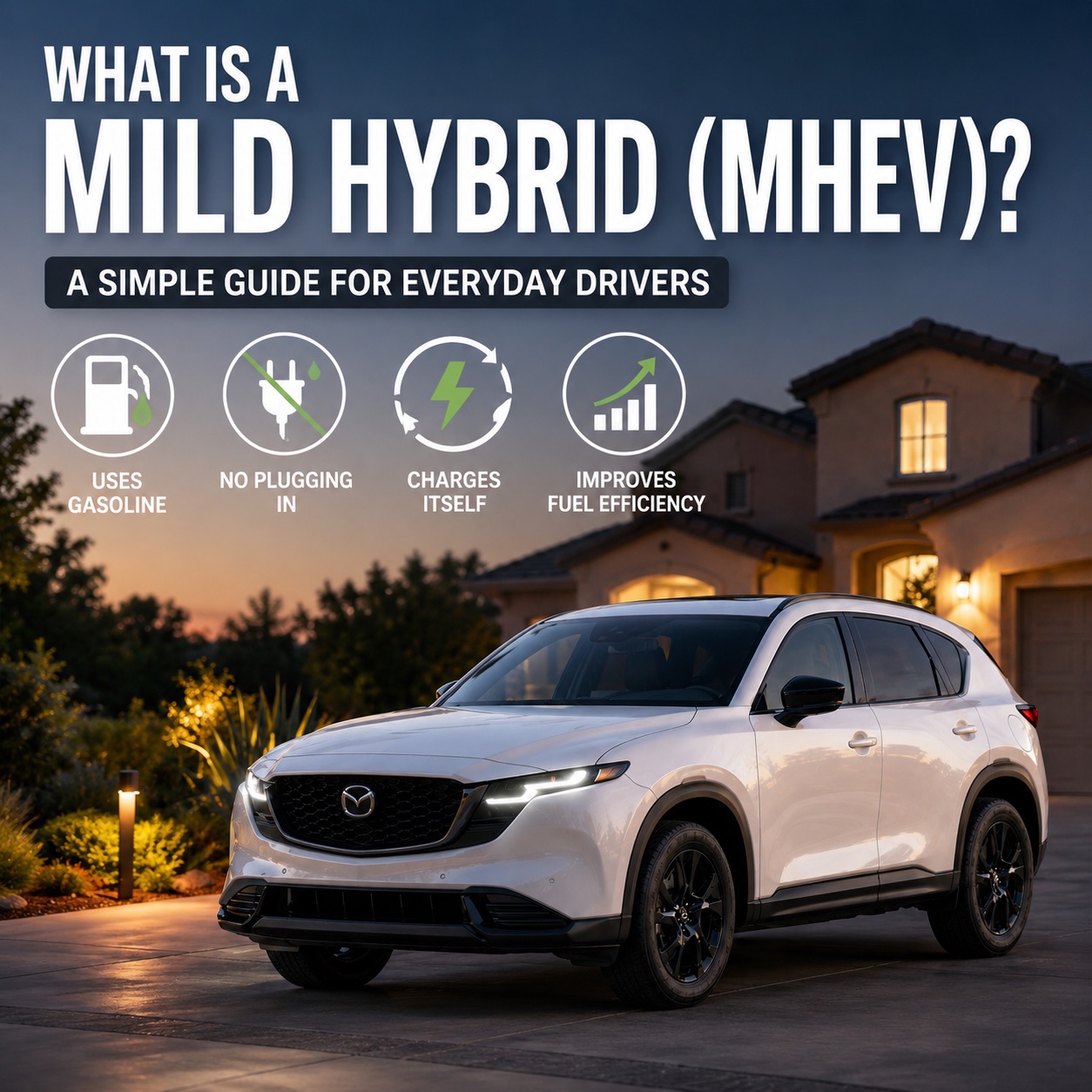
A mild hybrid electric vehicle, or MHEV, is a gasoline-powered vehicle that uses a small electric motor and battery to assist the engine. It does not need to be plugged in, and it generally cannot drive on electricity alone. The electrical system works automatically in the background to recover energy, support acceleration, and help the gasoline engine operate more efficiently.
Think of a mild hybrid as a gas vehicle with an electric helper. It gives drivers some electrification benefits without requiring a charging routine or a major change in how they use the vehicle.
So, How Does a Mild Hybrid Actually Work?
A mild hybrid combines a conventional gasoline engine with an electric motor-generator and a small battery. Many modern systems use a 48-volt electrical architecture, although the exact design varies by manufacturer and vehicle.
The gasoline engine still moves the vehicle. The electric side of the system supports it. Depending on the design, the motor-generator can restart the engine after a stop, add assistance during acceleration, power electrical accessories, and recover energy as the vehicle slows down.
The Mild-Hybrid Energy Loop
The vehicle captures some energy that would otherwise be lost as heat.
The recovered energy is stored in a small battery.
The motor uses that energy to support the gasoline engine.
No cable, charger, or driver input is required.
The important point is not the voltage or the location of the motor. It is what the system does: it captures energy, stores it, and reuses it to reduce some of the engine's workload.
Where Will You Notice the Difference?
At Stoplights
The motor-generator can restart the engine quickly after an automatic stop. A well-tuned system can make stop-start operation feel smoother and less abrupt than a basic starter motor.
Pulling Away From a Stop
The electric motor can provide a small amount of assistance as the vehicle begins moving. That support reduces the load placed on the engine during a moment when extra effort is often required.
While Slowing Down
Regenerative braking converts some of the vehicle's motion into electrical energy. You continue using the brake pedal normally while the vehicle manages the energy recovery.
During Daily Driving
The system can support efficiency without asking you to plan charging stops or monitor an electric range. That fits commuters who want electrification to work quietly in the background.
For a Tracy-area driver covering mixed suburban streets and freeway miles along I-205, I-5, or the I-580 connection, the biggest advantage is simplicity. The vehicle can use recovered energy during the same commute you already make, with no new charging habit to learn.
What Doesn't a Mild Hybrid Do?
A mild hybrid is useful, but it is important to understand its limits. The word hybrid does not mean every electrified vehicle works the same way.
- It does not normally drive on electricity alone. The electric motor is not designed to act as the vehicle's sole propulsion source.
- It does not replace the gasoline engine. Fuel is still required for normal driving.
- It does not need external charging. There is no daily plug-in routine.
- It does not provide the same electric capability as a full hybrid or PHEV. Those systems use more powerful motors and larger batteries.
- It does not guarantee a specific fuel-economy improvement. The result depends on the vehicle, system design, driving conditions, traffic, weather, and driving habits.
Mild Hybrid vs. Full Hybrid, Plug-In Hybrid, EV, and Gas
This comparison is the easiest way to understand where mild hybrid cars fit. A mild hybrid stays closest to a conventional gas vehicle. A full hybrid adds limited electric-only capability, a plug-in hybrid adds a chargeable battery and a longer electric mode, and an EV removes the gasoline engine entirely.
| Powertrain Comparison | |||||
|---|---|---|---|---|---|
| Question | Gas | Mild Hybrid | Full Hybrid | Plug-In Hybrid | EV |
| Uses a gasoline engine? | Yes | Yes | Yes | Yes | No |
| Can the motor propel the vehicle by itself? | No | Generally no | Yes, under some conditions | Yes | Yes |
| Needs to be plugged in? | No | No | No | Yes, to use its intended electric capability | Yes |
| Uses regenerative braking? | Usually no | Yes | Yes | Yes | Yes |
| Best understood as... | A traditional gasoline vehicle | A gas vehicle with electrical assistance | A self-charging gas-electric vehicle | An electric-capable hybrid with a gasoline backup | A fully electric vehicle |
The practical tradeoff is clear. A mild hybrid asks the least of the driver, but it also offers the least electric-only capability. A PHEV or EV can use more electricity, but it makes regular access to charging more important. A full hybrid sits between those choices by providing some electric propulsion without a plug.
Common Mild-Hybrid Myths
| Myth | Reality |
|---|---|
| “I have to plug it in.” | No. The system stores energy recovered while driving and braking. |
| “It can drive like an electric car.” | A typical MHEV cannot propel itself solely with its electric motor. |
| “The electric motor replaces the engine.” | The engine remains the primary power source. The motor assists it. |
| “Every vehicle labeled hybrid works the same way.” | Mild hybrids, full hybrids, and plug-in hybrids use different battery sizes, motor capabilities, and charging strategies. |
| “You have to change the way you drive.” | No special routine is required. The vehicle manages the system automatically. |
Is a Mild Hybrid Right for You?
A test drive still matters. Mild-hybrid systems differ in how noticeable the engine restart, regenerative braking, and electric assistance feel. Comparing the actual vehicles will tell you more than comparing labels alone.
Does Mazda Offer Mild Hybrid Vehicles?
Yes. Mazda offers mild-hybrid technology in the U.S. lineup, but shoppers should not assume every Mazda hybrid SUV uses the same type of system.
The current Mazda CX-70 with the inline-six powertrain uses Mazda's 48V M Hybrid Boost system. Mazda describes it as a Mild Hybrid Electric Vehicle because the electrical system assists the gasoline engine and helps reduce engine load without requiring plug-in charging.
The Mazda CX-50 Hybrid is different. It is a full hybrid, or HEV. Its gasoline engine works with multiple electric motors, and the vehicle can use electric power to propel itself for short distances and at low speeds under the right conditions. It also does not plug in, but it provides more electric propulsion capability than an MHEV.
Mazda also offers plug-in hybrid versions of the CX-70 and CX-90. Those vehicles use larger batteries that can be charged externally and can provide an electric driving mode before operating as hybrids for longer trips.
| Mazda Electrified SUV Examples | |||
|---|---|---|---|
| Mazda SUV | Powertrain Type | Plug In? | Key Distinction |
| Mazda CX-70 Inline 6 | Mild hybrid | No | 48V M Hybrid Boost assists the gasoline engine. |
| Mazda CX-50 Hybrid | Full hybrid | No | Electric motors can provide limited propulsion. |
| Mazda CX-70 PHEV | Plug-in hybrid | Yes | A chargeable battery supports electric-only driving. |
| Mazda CX-90 PHEV | Plug-in hybrid | Yes | Three-row utility with a chargeable hybrid powertrain. |
Model offerings, powertrains, trims, and availability can change. Verify current vehicle details before purchase.
Mild hybrids occupy the lightest end of the hybrid spectrum.
The defining difference is that their electric motors assist the engine but are not powerful enough to propel the vehicle independently. That distinction makes MHEVs easier to separate from full hybrids and plug-in hybrids while shopping.
Which Type of Electrified Vehicle Fits You?
| If You Want... | Start By Considering... |
|---|---|
| Electrical assistance with no charging routine and familiar gas-vehicle use | Mild hybrid |
| More electric operation without plugging in | Full hybrid |
| Electric commuting plus gasoline flexibility for longer trips | Plug-in hybrid |
| No gasoline engine and you have a practical charging plan | Battery-electric vehicle |
| The simplest familiar powertrain and no hybrid hardware | Gas-only vehicle |
The right answer depends on your driving pattern, access to charging, passenger and cargo needs, preferred vehicle, and budget. Start with the routine you need the vehicle to handle, then compare the technology.
The Bottom Line
A mild hybrid is not an electric car and not a full hybrid. It is a gasoline vehicle with an electrical system that assists the engine, captures braking energy, and supports smoother, more efficient operation without requiring a plug.
That makes an MHEV a strong fit for shoppers who want electrification to stay simple. You fill the tank, drive normally, and let the vehicle manage the battery and motor in the background.
The label alone should not make the decision. Compare the actual Mazda hybrid cars and SUVs, understand whether each one is an MHEV, HEV, or PHEV, and choose the system that best matches your commute, charging access, space needs, and long-term ownership plans.
Compare Mazda Hybrid Options at Tracy Mazda
Tracy Mazda can help you compare a mild-hybrid Mazda CX-70, the full-hybrid Mazda CX-50 Hybrid, and available Mazda plug-in hybrid SUVs. Review current inventory online or contact the dealership for help matching the powertrain to the way you drive.
Frequently Asked Questions
Research, Finance, or Trade From Home
Tracy Mazda has served the Tracy community since October 2005. Shoppers can review inventory, begin financing, estimate a trade, or contact the team online before visiting 2680 Auto Plaza Drive in Tracy.
DISCLAIMER:
*This page provides general educational information. Mild-hybrid system design, operation, terminology, fuel economy, features, trims, and vehicle availability vary by manufacturer, model, model year, and configuration. Verify current information with the manufacturer and dealership before purchase. Actual fuel economy will vary based on vehicle condition, traffic, weather, route, driving habits, cargo, passengers, and other factors. Hybrid and high-voltage components should be inspected and serviced only according to manufacturer procedures.