2026 Mazda CX-70 vs CX-90
September 08 2026
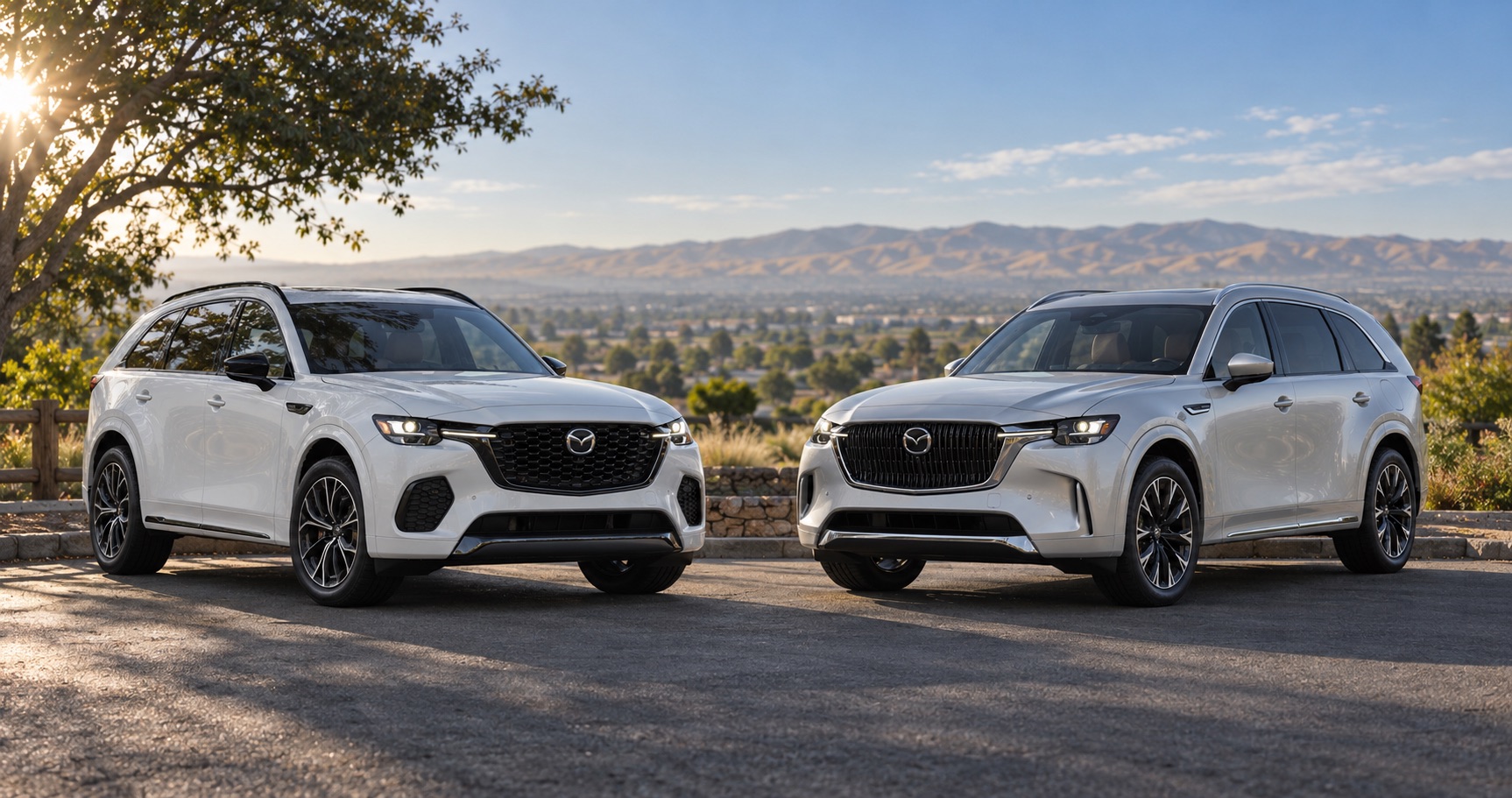
2026 Mazda CX-70 and 2026 Mazda CX-90 overlooking Tracy, CA

Mazda Midsize SUV Comparison

2026 Mazda CX-70 vs Mazda CX-90
Which SUV Fits You?

Nearly the Same SUV Underneath.
The Real Choice Is Two Rows or Three.


The 2026 Mazda CX-70 and 2026 Mazda CX-90 make an unusual comparison because their badge numbers suggest a conventional smaller-SUV-versus-larger-SUV choice. That is not what Mazda built. They share essentially the same large-SUV architecture, exterior footprint, first-two-row packaging, and core Inline-6 and plug-in-hybrid choices. Shoppers are really choosing between two ways to use the same basic vehicle.

The meaningful split begins behind the second row. CX-70 is built around five seats and a cargo-first rear cabin. CX-90 uses that same overall footprint to add a third row when family, carpools, or extra passengers make more seating useful. Fold that third row and the two become remarkably close for cargo, which is why CX-70's case is not that it is dramatically roomier; it is that the rear of the SUV stays dedicated to cargo all the time.

That distinction fits the way one SUV may be used around Tracy: I-205 and I-580 commuting during the week, school and errand duty in between, then luggage, sports equipment, or gear for weekends toward the Delta, Bay Area, or Sierra. If row three solves a recurring people problem, CX-90 has a clear purpose. If five seats are enough, CX-70 is the more focused two-row interpretation, with styling, PHEV efficiency, and trim pricing left to break a closer tie.


Which Cabin Role Fits Your Routine?

Because the CX-70 and CX-90 share so much underneath, start with the only question that can fundamentally change the cabin: how often will a third row earn its space?

Based on This Priority

Five Seats Cover My Normal Routine

Start With the CX-70

Who This Favors

Households that normally carry five or fewer people and would rather keep the rear of the SUV permanently available for luggage, sports gear, pets, projects, or weekend equipment.

Why It Points Here

CX-70 keeps 39.6 cubic feet ready behind row two while sharing the CX-90's overall length, wheelbase, core powertrains, and upper towing ceiling.

CX-70 vs CX-90 in 60 SecondsFive answers that separate the shared foundation from the real differences

Are the 2026 Mazda CX-70 and CX-90 basically the same SUV?
They are near twins in the areas that usually separate two models: exterior footprint, platform, first- and second-row space, powertrain choices, AWD, and upper towing capability. The main structural difference is that CX-70 stops at two rows while CX-90 adds a third.


Does the CX-70 give you a smaller exterior or much more maximum cargo room?
No. Both are 200.8 inches long on a 122.8-inch wheelbase. CX-70 reaches 75.3 cubic feet maximum, while CX-90 reaches 74.2 to 75.2 depending on seating configuration. CX-70's useful cargo distinction is keeping 39.6 cubic feet open behind row two whenever all five seats are occupied.


Do they share the same powertrain and towing choices?
Yes. Both offer 280-horsepower and 340-horsepower Turbo Inline-6 mild-hybrid paths plus a 323-horsepower PHEV. Eligible Inline-6 trims of either model can tow up to 5,000 pounds when properly equipped, while both PHEV lineups top out at 3,500 pounds.


What differences remain after seating?
CX-70 leans into a blacked-out exterior theme and its 2026 PHEV is currently rated at 32 electric miles and 61 MPGe. CX-90 offers more passenger configurations, and its PHEV is rated at 27 electric miles and 56 MPGe. Those are useful tie-breakers, but they are smaller than the two-row-versus-three-row decision.


Does the CX-90 really cost less than the CX-70?
It has the lower absolute entry price because CX-90 starts with a $39,300 Turbo Select while CX-70 begins at the better-equipped $42,750 Turbo Preferred. Compare Preferred to Preferred and the gap shrinks to $700: $42,750 for CX-70 versus $43,450 for CX-90. The badges do not create a simple two-row-cheaper, three-row-more-expensive price ladder.
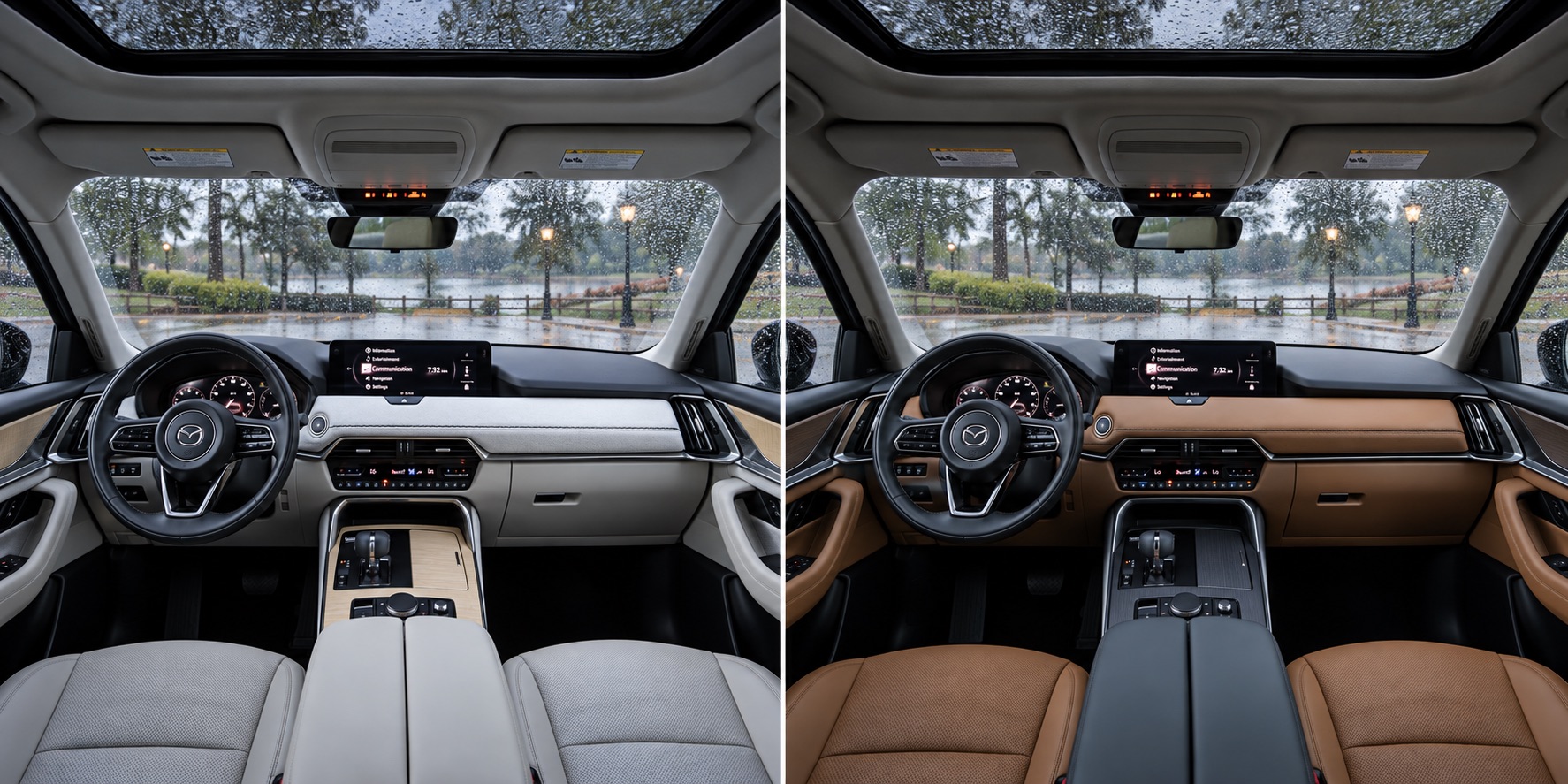

2026 Mazda CX-70 and 2026 Mazda CX-90 interiors shown side by side on a rainy day

Separate What Is Shared From What Can Actually Change the Decision

Most of the usual comparison categories collapse quickly because these Mazdas share the same footprint, platform, core powertrains, first- and second-row room, and upper towing ceiling. Use the panels below to isolate the cabin-role difference first, then the styling, PHEV, and trim-pricing details that can break a genuine tie.

Start With the Cabin Role; Use the Rest as Tie-Breakers

Start Here

Think of Them as One Large-SUV Formula With Two Cabin Jobs

The shared rows below matter because they remove several false tie-breakers. The model choice starts only where the cabin mission or trim strategy actually separates.

2026 Mazda CX-70 vs Mazda CX-90 at a Glance
Category 2026 Mazda CX-70 2026 Mazda CX-90
Core Role Two rows / 5 passengers
Dedicated cargo area behind row 2
Three rows / 7 or 8 passengers
Seating varies by trim and configuration
Exterior Footprint 200.8-in length / 122.8-in wheelbase / 84.9-in mirror-to-mirror width
Effectively the same parking and garage footprint
Front / 2nd-Row Legroom 41.7 / 39.4 in
Core Powertrains 280-hp 3.3L Turbo Inline-6 M-Hybrid
Up to 340-hp Turbo S Inline-6 M-Hybrid
323-hp PHEV
8-speed automatic and AWD across both model families
Cargo With Passenger Rows in Use 39.6 cu ft behind row 2
All 5 seats remain available
14.9-15.9 cu ft behind row 3
40.0-40.1 cu ft
with row 3 folded
Maximum Cargo 75.3 cu ft 74.2-75.2 cu ft
varies by third-row configuration
Maximum Towing* Up to 5,000 lb on eligible Inline-6 trims
Up to 3,500 lb on PHEV models
Starting Price Context* $42,750
3.3 Turbo Preferred
$39,300
3.3 Turbo Select
$43,450
3.3 Turbo Preferred
Starting MSRP excludes the $1,645 destination and handling charge, tax, title, license fees, options, accessories, dealer-installed equipment, and dealer charges. Towing requires the applicable trim, proper equipment, and Mazda Genuine Towing Accessories where specified.

The Badge Number Does Not Buy a Different Size or Mechanical Class

Choose CX-70 because five seats are enough and you prefer a dedicated two-row cargo layout—not because it is shorter, substantially roomier for cargo, more powerful, or meaningfully easier to park. Choose CX-90 because the third row has a real job to do; most of the underlying SUV remains the same.

The Main Decision

Will the Third Row Earn Its Space Often Enough?

The first two rows are the same size on paper. The difference is whether the rear cabin should stay cargo-first or become passenger space when needed.

Seating & Cargo Comparison
Category 2026 Mazda CX-70 2026 Mazda CX-90
Seating Capacity 5 passengers
2 rows
Inline-6: 7 or 8 passengers
PHEV: up to 7 passengers
configuration varies by trim
Front / 2nd-Row Legroom 41.7 / 39.4 in
3rd-Row Legroom No third row 30.4 in
Cargo With All Passenger Rows Raised 39.6 cu ft
behind row 2
14.9-15.9 cu ft
behind row 3
Cargo Behind Row 2 39.6 cu ft
always open behind row 2
40.0-40.1 cu ft
with row 3 folded
Maximum Cargo 75.3 cu ft
row 2 folded
74.2-75.2 cu ft
rows 2 and 3 folded; varies by configuration
How the Rear Cabin Is Used Cargo-first layout
Underfloor storage and remote-folding rear seats support the dedicated two-row role.
Passenger-flexible layout
Row 3 can carry people or fold to return essentially the same behind-row-2 cargo volume.
Cargo measurements vary with seating configuration. Real-world fit also depends on seat position, floor shape, loading height, and the dimensions of your normal gear.

CX-70 Has More Ready Cargo, Not Meaningfully More Maximum Cargo

Fold the CX-90 third row and it actually provides about the same 40 cubic feet behind row two as CX-70. Fold every rear seat and the maximums are also effectively tied. CX-70 is cleaner when five seats are enough because that cargo space never has to compete with row three; CX-90 is cleaner when extra seats solve a recurring passenger problem.

Around Tracy, that can mean leaving the CX-70 ready for sports bags, strollers, Delta gear, or luggage for a Sierra weekend while all five seats remain usable. CX-90 earns its extra flexibility when carpools, visiting family, or group trips regularly put a sixth or seventh person in the SUV.

Secondary Tie-Breakers

When Seating Is a Toss-Up, Which Details Give Each SUV Its Own Character?

The CX-70 is more than a CX-90 with one row removed, but these styling and cabin details should settle close calls rather than outweigh a genuine need for more seats.

Styling & Cabin Details
Comparison Point 2026 Mazda CX-70 2026 Mazda CX-90
Exterior Identity Black-out theme across the 2026 lineup
Gloss-black Mazda emblems and rear badges; Preferred adds 21-inch black-finish wheels and additional black exterior details.
More trim-dependent exterior treatment
Premium Sport and Turbo S Premium Sport bring 21-inch Black Metallic wheels and black exterior trim.
Distinctive Cabin Choices Two-row cabin with expressive upper-trim finishes
Available Red Nappa leather on Turbo S Premium and Tan Nappa leather on Turbo S Premium Plus.
Passenger-flexible upper-trim cabin
Available Nappa leather; Turbo S Premium Plus adds second-row captain's chairs with a center console and ventilated second-row seats.
Rear-Cabin Details Cargo-focused conveniences
Additional underfloor storage and remote-folding second-row seatbacks support the dedicated two-row layout.
Passenger-focused flexibility
Second-row bench or captain's-chair configurations vary by trim, with row three available when extra seating matters.

CX-70 Has the More Deliberately Sporty Two-Row Identity

When row three is not valuable, CX-70 gives the shared Mazda foundation a more focused identity through its lineup-wide black-out theme, dedicated cargo details, and distinctive available cabin treatments. CX-90 remains the more flexible family-oriented choice, and its Premium Sport trims can add their own darker exterior treatment. These differences are useful tie-breakers, not reasons to override a real third-row need.

A Real but Secondary Difference

Does the CX-70 PHEV Advantage Change the Cabin Decision?

The plug-in systems share the same core output and battery capacity. CX-70 currently carries a modest efficiency and EV-range edge, while CX-90 keeps the third row.

2026 CX-70 PHEV vs CX-90 PHEV
Category 2026 Mazda CX-70 PHEV 2026 Mazda CX-90 PHEV
PHEV System 323 hp / 369 lb-ft
17.8-kWh battery
8-speed automatic / AWD
EPA EV Range* 32 miles 27 miles
EPA Combined MPGe* 61 MPGe 56 MPGe
Seating 5 passengers Up to 7 passengers
PHEV Entry Price* PHEV SC — $44,450
lower-priced PHEV entry trim
PHEV Preferred — $50,695
starts at a richer equipment position
Trim-Ladder Context 2 PHEV configurations
SC / SC Plus
3 PHEV configurations
Preferred / Premium Sport / Premium Plus
The 2026 EPA-estimated EV ranges are 32 miles for CX-70 PHEV and 27 miles for CX-90 PHEV. The two PHEV lineups start at different equipment positions, so the entry-price gap is not a direct same-equipment comparison. Actual electric range and efficiency vary with charge, temperature, route, load, accessories, and driving conditions.

Five More Rated EV Miles Are Useful; Seven Seats Are a Different Kind of Utility

CX-70's five-mile EV-range and five-MPGe advantages are real, but modest enough that they should refine a PHEV decision rather than override a genuine third-row need. Its much lower PHEV entry price is also partly a trim-structure story: CX-70 starts with PHEV SC, while CX-90 begins at PHEV Preferred.

For shorter Tracy-area errands, the extra rated EV range can help more of the day fit inside the electric-driving window. On longer Bay Area, Sacramento, or Sierra drives, the five-mile difference becomes much less important than whether the cabin has the passenger capacity you need.

Price & Trim Strategy

Is the CX-90 Really the Cheaper SUV—or Does It Just Start Lower?

The lowest MSRPs exaggerate the model-level price difference because CX-90 adds a Select trim beneath the Preferred level where CX-70 begins.

Trim & Price Context That Actually Helps
Comparison Point 2026 Mazda CX-70 2026 Mazda CX-90
Lowest Inline-6 Entry* Preferred — $42,750
CX-70 begins at Preferred
Select — $39,300
lower equipment entry point
Preferred-to-Preferred* Preferred — $42,750 Preferred — $43,450
$700 higher
Closest High-Output Entry* Turbo S Premium — $53,440 Turbo S Premium Sport — $54,140
$700 higher; trim content is not identical
Turbo S Premium Plus* $56,870 $57,570
$700 higher
PHEV Entry* PHEV SC — $44,450 PHEV Preferred — $50,695
different equipment starting points
Lineup Breadth 7 configurations
5 Inline-6 + 2 PHEV
9 configurations
6 Inline-6 + 3 PHEV
Current starting MSRP figures exclude the $1,645 destination and handling charge, tax, title, license fees, options, accessories, dealer-installed equipment, and dealer charges. Named trims are not guaranteed to be equipment-identical; use the exact feature list and transaction price when narrowing a purchase.

At Comparable Inline-6 Positions, the Third Row Is Not a Large Price Penalty

CX-90's $3,450 lower advertised starting point comes from a Select trim that CX-70 does not offer. At Preferred, CX-90 is only $700 more; the nearest high-output entry and the Turbo S Premium Plus comparison also land $700 apart. That makes the Inline-6 model decision more about whether row three has value than about one badge being meaningfully cheaper.

PHEV is the clearer price separation, but even there the two lineups start at different equipment levels. CX-70's lower-cost PHEV entry is attractive when five seats are enough; CX-90's higher starting point buys into a three-row PHEV lineup with a richer standard equipment position.


Third-Party Review Context

Third-Party Reviews Reinforce the Near-Twin Reality

Car and Driver's current 2026 coverage reaches the same basic conclusion as the specifications: the CX-70 and CX-90 are extremely close beneath the seating layouts. Their 8.5/10 and 8/10 ratings are only half a point apart, so the useful outside perspective is the premium cabin and agile road character they share—not treating a small score gap as a verdict.

Car and Driver

2026 Mazda CX-70

8.5/10 Rating

A five-seat version of the same basic formula. Car and Driver describes the CX-70 and CX-90 as essentially identical apart from seat count while praising the CX-70's power, nimble handling, and upscale cabin. That supports the CX-70's role as the more focused two-row expression of the shared Mazda package rather than a smaller or mechanically different SUV.

Car and Driver

2026 Mazda CX-90

8/10 Rating

The same driving character with a third row added. Car and Driver praises the CX-90's premium-looking interior, fuel economy for its size, and nimble handling, and its current coverage points shoppers who only need five seats toward the near-identical CX-70. That keeps the third row—not a different performance class—as the meaningful model-level distinction.

Ready for a Back-to-Back Drive

Because the Road Manners Are So Similar, Spend More Time Testing the Cabin

When possible, compare similar Inline-6 or PHEV configurations so the shared driving character does not distract from the real question. Bring the passengers and gear that reflect your normal week, then fold and raise the CX-90 third row, check access with the people who would use it, and compare the exact trim prices you would actually pay.
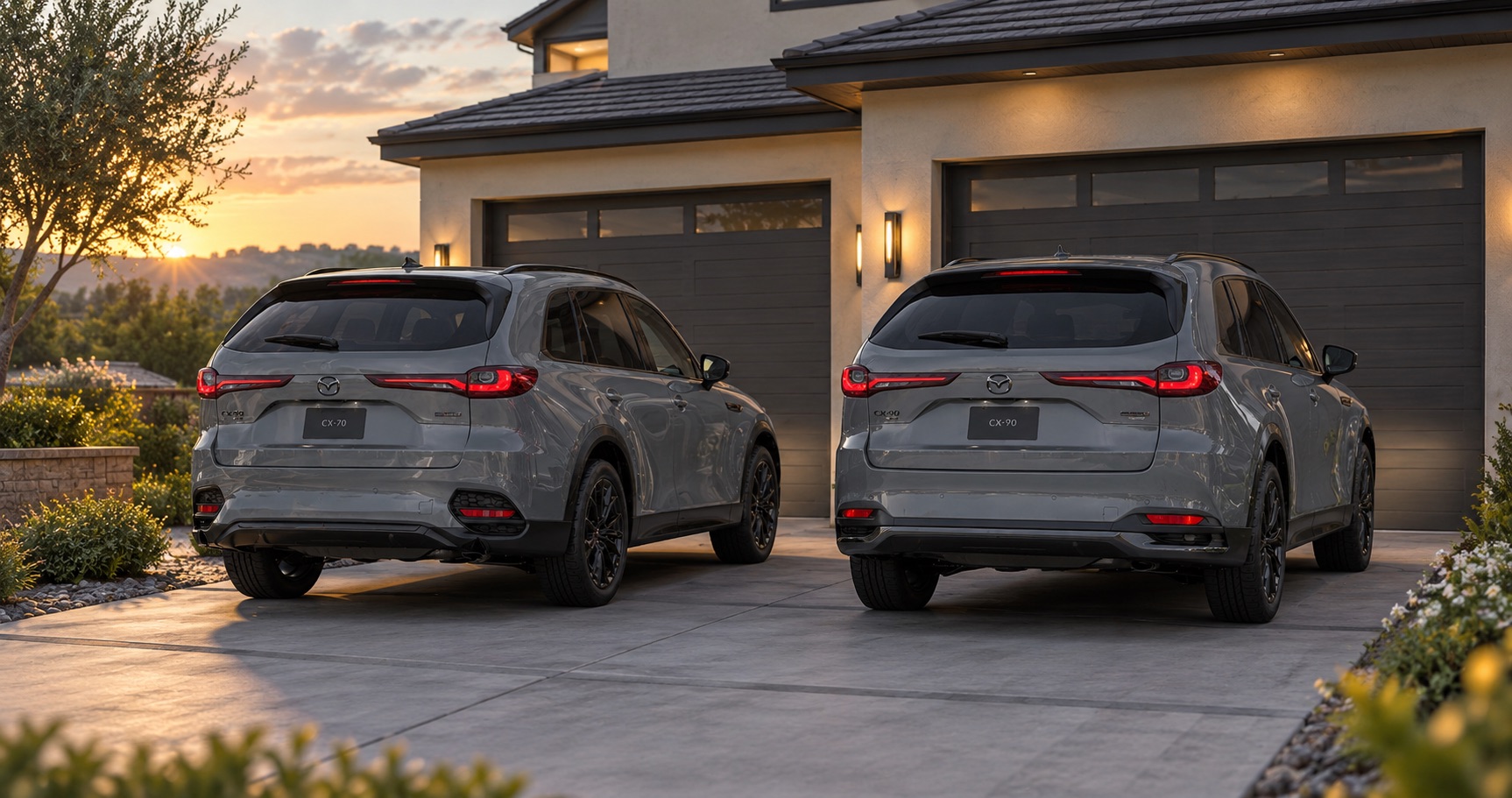
2026 Mazda CX-70 and 2026 Mazda CX-90 parked in a residential driveway in Tracy, CA

What the Near-Twin Reality Means

Let the Third Row Decide the Model;
Let Trim & Powertrain Decide the Version

CX-70 is the cleaner fit when five seats cover the routine. Its cargo advantage is not a dramatically larger maximum; it is having roughly 40 cubic feet ready behind row two all the time, along with dedicated two-row storage details and a more consistently blacked-out exterior identity. For Tracy households that regularly carry sports gear, pets, work equipment, or luggage for Delta and Sierra weekends, that simpler cargo-first setup can be the more useful version of the shared Mazda formula. If you are shopping PHEV, its current 32-mile EV rating and 61-MPGe figure add a modest efficiency edge.

CX-90 is the cleaner fit when a sixth, seventh, or eighth seat will solve a real recurring problem. You are not paying for a longer SUV or giving up the shared Inline-6 choices, AWD system, first- and second-row room, or 5,000-pound upper tow ceiling. And once you move past the lower Select entry trim, the Inline-6 price difference can be surprisingly small: CX-90 Preferred is only $700 above CX-70 Preferred. If row three has genuine value, that makes the CX-90 difficult to dismiss on price alone.

If the third row would stay folded most weeks, CX-70 becomes the more purposeful starting point. It keeps the same core size and mechanical choices while dedicating the rear cabin to the job you use more often. Compare both if exact trim content, styling, PHEV use, or transaction price keeps the decision close; otherwise, CX-90 should earn its place by solving a passenger-capacity need you can name.

Still Between the Two?
Use Four Questions to Test Whether Row Three Really Matters.

4-Question Decision Check

Find Your Better Mazda Starting Point

Because the shared hardware removes so many tie-breakers, four questions are enough to test whether the third row, dedicated cargo layout, PHEV differences, or trim strategy should lead your first test drive.

Question 10 answered

Decision question


2026 Mazda CX-70 vs CX-90 FAQs

What is the main difference between the 2026 Mazda CX-70 and CX-90?

The CX-70 is a two-row, five-passenger midsize SUV, while the CX-90 adds a third row and can seat seven or eight depending on trim and configuration. They otherwise share nearly identical exterior dimensions, the same Large Platform, standard AWD, and closely matched Inline-6 and PHEV powertrains.

Are the Mazda CX-70 and CX-90 the same size?

For practical comparison purposes, yes. Mazda publishes a 200.8-inch body length and 122.8-inch wheelbase for both, along with the same 84.9-inch mirror-to-mirror width. Height varies slightly by trim and wheel specification.

Which has more cargo space, the CX-70 or CX-90?

The CX-70 provides 39.6 cubic feet behind its second row and 75.3 cubic feet with that row folded. The CX-90 provides 14.9 to 15.9 cubic feet behind its third row, about 40.0 to 40.1 cubic feet with the third row folded, and up to 74.2 to 75.2 cubic feet with both rear rows folded. The biggest CX-70 benefit is having about 40 cubic feet ready without folding a third row.

Do the 2026 CX-70 and CX-90 have the same engines?

They offer the same basic powertrain choices: a 280-horsepower 3.3-liter Turbo Inline-6 with M-Hybrid Boost, a Turbo S version with up to 340 horsepower on recommended premium fuel, and a 323-horsepower plug-in hybrid system. All use an eight-speed automatic and all-wheel drive.

Which PHEV goes farther on electricity, the 2026 CX-70 or CX-90?

The 2026 CX-70 PHEV is EPA-estimated for 32 miles of electric range, compared with 27 miles for the 2026 CX-90 PHEV. The CX-70 PHEV is rated at 61 MPGe combined and the CX-90 PHEV at 56 MPGe combined. The five-mile range gap is useful context, but seating remains the larger model-level difference.

Can both the Mazda CX-70 and CX-90 tow 5,000 pounds?

Eligible Inline-6 trims of both model lines can tow up to 5,000 pounds when properly equipped with Mazda Genuine Towing Accessories. Lower Inline-6 trims are rated up to 3,500 pounds, and both PHEV model lines are rated up to 3,500 pounds when properly equipped.

Why does the CX-90 start at a lower MSRP than the CX-70?

The CX-90 lineup includes a lower 3.3 Turbo Select entry trim at $39,300, while the CX-70 begins at 3.3 Turbo Preferred at $42,750. That $3,450 base gap compares different equipment positions. Preferred to Preferred, the CX-70 is $42,750 and the CX-90 is $43,450, only $700 apart before destination and other fees.

Where can I compare a Mazda CX-70 and CX-90 near Tracy, CA?

Tracy Mazda is located at 2680 Auto Plaza Dr in Tracy, California. Shoppers can review current CX-70 and CX-90 inventory online, start trade and financing steps remotely, and then compare seating, cargo access, visibility, and driving feel in person.


Why Tracy Mazda Makes the Next Step Easier

Tracy Mazda has served the Tracy community since its October 2005 grand opening. For Central Valley and Tracy-to-Bay shoppers, that means working with a long-established local Mazda store that can support the process from initial research through purchase and the ownership years that follow.

Much of the early planning can happen before a visit to 2680 Auto Plaza Dr. Current inventory can narrow the configurations worth seeing, the online trade tool can establish an early value estimate, the finance application can begin remotely, and Tracy Mazda's buy-from-home process can move much of the purchase forward without an extra preliminary dealership trip. For a household already balancing an I-205/I-580 commute, work, school, and family schedules, that can turn dealership time into a focused in-person visit instead of a series of setup trips.

The convenience continues after delivery through online service scheduling, a factory-trained Mazda service team, and current service specials. The real-world benefit is continuity: maintenance and repair support can stay with the same nearby dealership, and appointments can be planned online rather than starting the ownership process over each time service is due.

Start Shopping or Keep Researching

Use the model and electrified-powertrain guides for the few questions that remain after the seating decision. When the cabin role is clear, move into exact inventory, trade value, financing, and current model-specific offers.


Disclaimers:
*Vehicle specifications, equipment, trims, powertrains, seating configurations, inventory, incentives, and prices may change. Verify the exact vehicle before making a purchase decision.
*Starting MSRP figures exclude the $1,645 destination and handling charge ($1,690 in Alaska), tax, title, license fees, options, accessories, dealer-installed equipment, and dealer charges. Dealers set actual sale prices.
*EPA fuel-economy, MPGe, and EV-range ratings are estimates for comparison. Actual results vary with charge level, traffic, weather, temperature, vehicle condition, loading, accessories, fuel, maintenance, and driving habits.
*M-Hybrid Boost is Mazda's 48-volt mild-hybrid assist system and is not a plug-in powertrain. CX-70 and CX-90 PHEV models use a separate plug-in-hybrid system and require external charging to maximize electric driving.
*Cargo capacities vary by seating configuration and measurement method. Real-world fit depends on seat position, floor shape, loading height, passengers, accessories, and the dimensions of your cargo.
*Towing capacities require the applicable trim, proper equipment, Mazda Genuine Towing Accessories where specified, and adherence to Mazda requirements. Maximum ratings must be reduced for applicable passenger, cargo, hitch, and optional-equipment weight. Towing affects handling, braking, durability, performance, and fuel economy.
*Car and Driver 8.5/10 CX-70 and 8/10 CX-90 ratings and review conclusions were checked on September 8, 2026. Ratings and review observations reflect Car and Driver's editorial assessment and may change as coverage is updated.
*Mazda driver-assistance technologies do not replace attentive driving. System operation can be affected by speed, weather, road conditions, visibility, objects, lane markings, and other factors.
*Tracy Mazda online shopping, trade, finance, inventory, service scheduling, and special-offer availability and terms may change. Online tools can begin or support the process; final purchase, lease, finance, trade, and service details remain subject to dealership and applicable lender/program review.